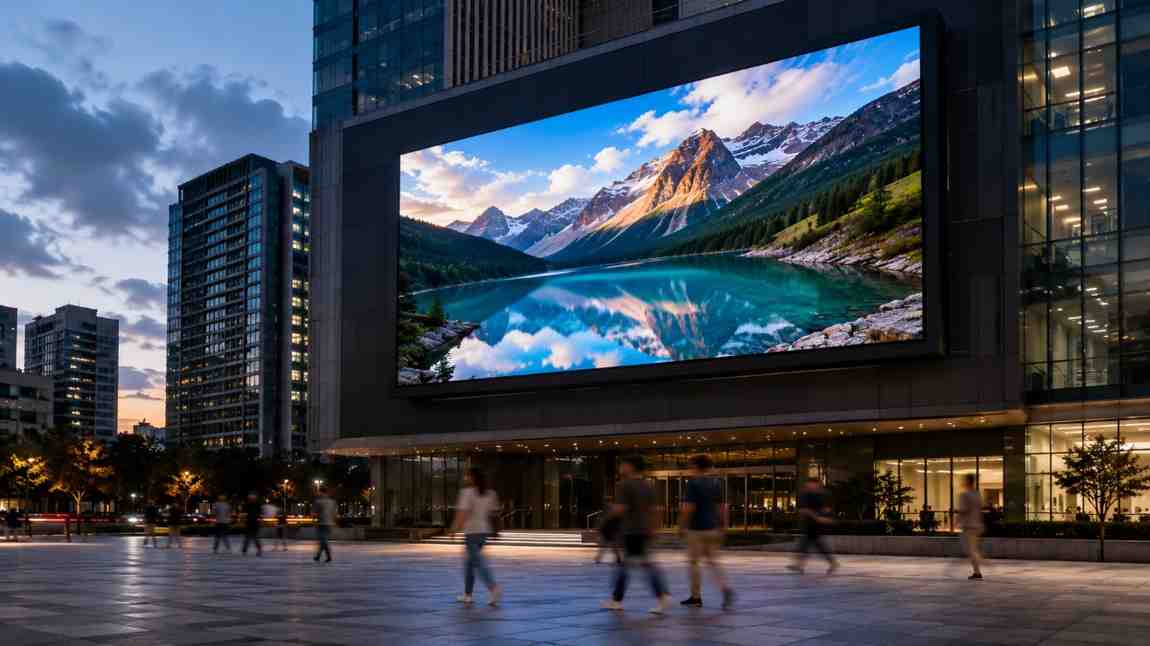
But buying the wrong screen? That costs you time, money, and a fair amount of frustration. This guide is here to make sure that does not happen.
What Is an Outdoor LED Screen Display?
An outdoor LED screen display is a high-brightness, weather-resistant digital screen designed to operate reliably in open-air environments. Unlike indoor screens, outdoor units are engineered to handle direct sunlight, rain, wind, dust, and temperature changes while delivering vivid, readable content to audiences from varying distances.
The term covers a wide range of products, from compact portable screens used at market stalls and events, to large permanently mounted panels on building facades, retail forecourts, and transport hubs.
What they all share is a core set of requirements: brightness that beats the sun, protection that laughs at rain, and content flexibility that keeps your messaging relevant every single day.
Why Outdoor LED Screens Outperform Every Other Format
Let us be direct about this. Printed banners fade. A-frame signs get knocked over. Static posters become invisible to people who walk the same route every day. An outdoor LED screen display has none of those problems.
According to research published by the Out of Home Advertising Association of America, digital out-of-home displays generate recall rates significantly higher than static formats, with audiences up to 47% more likely to remember content shown on a digital screen than on a printed equivalent.
I have noticed this firsthand at outdoor events where side-by-side exhibitors, one with a printed banner and one with a bright LED screen, attract noticeably different levels of foot traffic. The screen wins almost every time, even when the printed banner has better graphic design.
The reasons are straightforward:
- Motion attracts attention instinctively and immediately
- Content updates in real time without any physical intervention
- Visibility at distance means your message reaches people before they are even close
- Day and night performance means your screen works the full day without adjustment
Key Specifications You Must Understand
This is where most buyers go wrong. They focus on screen size and price and ignore the specs that actually determine whether the screen performs in the real world.
Brightness: The Single Most Important Spec
Indoor screens run at 300 to 500 nits. That is fine for a controlled lighting environment. Step outside on a New Zealand summer afternoon and a 500-nit screen is essentially invisible.
For outdoor use, 2500 nits is your absolute minimum. Screens facing direct north or west sun benefit from 3000 to 5000 nits. The Dynamic Displays 43-inch outdoor portable screen delivers 2500 nits as standard, which covers the vast majority of outdoor conditions across New Zealand reliably.
IP Rating: Your Weather Protection Guarantee
IP stands for Ingress Protection. The rating tells you how resistant the screen is to solids like dust and liquids like rain. For outdoor use in New Zealand:
- IP65 is the baseline: fully dust-tight, protected against water jets from any direction
- IP66 offers stronger water resistance and is worth considering for coastal or high-rainfall locations
- Anything below IP65 is not suitable for permanent or semi-permanent outdoor use
Do not let a supplier talk you into an unrated screen for outdoor installation. It will fail.
Panel Type: IPS vs Standard LCD
IPS panels provide wide viewing angles, meaning content remains visible and colour-accurate even when viewers are approaching from the side rather than standing directly in front. In outdoor environments where foot traffic comes from multiple directions, this matters enormously.
A standard LCD panel viewed from a 45-degree angle can look washed out or colour-shifted. An IPS panel stays consistent. For retail frontages, event booths, and public spaces, IPS is the right choice.
Refresh Rate: Smooth Content Under Camera
If your screen will ever be in photographs, livestreams, or event videos, refresh rate becomes critical. A screen with a low refresh rate produces a visible flicker when captured on camera. This looks unprofessional and undermines your brand in any content your customers share.
Look for a refresh rate of 1920Hz or higher on any outdoor LED screen display that might end up in media coverage or social content.
Battery Capacity for Portable Screens
For portable outdoor LED screens, battery life determines how useful the screen actually is in the field. A 4-hour battery might be fine for a short morning market. A full-day event, exhibition, or multi-session outdoor activation needs 10 hours of runtime as a minimum.
Types of Outdoor LED Screen Displays
Understanding the different formats helps you match the right product to your actual use case.
Portable Freestanding Outdoor Screens
Battery-powered, lightweight, and fully self-contained. These screens require no installation, no electrician, and no permanent commitment. Roll them out, switch them on, and you have a high-impact display wherever you need it.
This format is ideal for:
- Markets, fairs, and pop-up retail
- Exhibition and trade show booths
- Outdoor hospitality and events
- Real estate display suites and show homes
- Temporary promotional campaigns
The second-generation portable screen from Dynamic Displays includes features like mobile app control, GPS anti-theft tracking, hidden interface ports, front stereo speakers, and a secure locking bar, all built into a slim, piano-finish unit that looks as good as it performs.
Permanent Wall-Mounted Outdoor Displays
Fixed to a building exterior or purpose-built mounting structure, these screens are the go-to for businesses wanting a consistent, long-term outdoor presence. They require professional installation including structural assessment, weatherproof cabling, and power supply work, but they deliver the most reliable and visible performance once installed.
Retail stores, restaurants, petrol stations, and corporate campuses all use this format regularly.
Pole-Mounted Outdoor LED Screens
Freestanding on a single or double pole, these displays are common in car parks, forecourts, event grounds, and roadside locations where wall mounting is not possible. Height can be adjusted to optimise visibility, and the mounting structure can often accommodate screens on multiple faces for wider coverage.
Large Format Outdoor LED Panels
Custom-built modular LED panel arrays for billboard-scale installations. These are used in stadiums, large retail precincts, transport hubs, and building facades. They are engineered to specification and represent a longer-term infrastructure investment.
Outdoor LED Screen Displays Across Industries
Food and Hospitality Cafés, restaurants, and food trucks use outdoor screens to display menus, daily specials, and promotions in a format that is visible from across the street. Updating a daily special takes thirty seconds from a phone. Reprinting a menu board takes a day and a budget.
Retail Storefront outdoor screens pull passing foot traffic inside. A well-timed animation or promotional loop in a retail window or forecourt creates urgency and visibility that a printed sign simply cannot match. In my experience, retailers who make the switch consistently report increased walk-in traffic within the first few weeks.
Events and Exhibitions This is one of the highest-impact uses of portable outdoor LED screen displays. A professional screen at an event booth signals seriousness, builds brand credibility, and communicates far more information than any printed material could. Audio-enabled screens add another dimension entirely.
Real Estate and Property Development Development site hoardings and on-site sales offices increasingly use outdoor LED screens to showcase renders, available lots, floor plans, and contact information in a format that engages buyers and keeps content current as availability changes.
Healthcare and Education Outdoor campus screens for hospitals, clinics, schools, and universities serve wayfinding, event promotion, and safety communication functions. A single screen at a main entrance can replace a dozen static signs and be updated centrally in moments.
Automotive and Service Businesses Car dealerships, service centres, and fuel retailers use outdoor LED screens to promote current offers, service specials, and brand messaging to passing traffic. High-brightness screens remain visible at road speeds, making them one of the most effective formats for roadside communication.
Installing an Outdoor LED Screen Display: What to Plan For
A lot of the value in a screen comes down to how well it is installed. Here is what to think through before committing.
Site Assessment Where exactly will the screen sit? What is the ambient light level throughout the day? Is there a power source nearby? What are the wind loads? Are there any council or landlord approvals required for a permanent installation?
Mounting and Structural Requirements Permanent outdoor screens carry real weight and catch real wind. The mounting structure needs to be engineered for the load, especially in exposed locations. Wellington's notorious winds demand more than a standard wall bracket.
Cable and Power Management Weatherproof conduit, correct cable ratings for outdoor use, and appropriate circuit protection are not optional extras. They are what keep a screen running safely year after year.
Content System Setup Before the screen goes live, the content management system needs to be configured. Who has access? How are updates pushed? Are playlists scheduled? Is there a fallback if connectivity drops? Sorting this out at installation time saves significant frustration later.
Ongoing Maintenance Outdoor screens face conditions indoor screens never encounter. Schedule regular checks of panel seals, mounting hardware, ventilation, and software updates. A well-maintained screen delivers consistent performance for years. A neglected one develops faults that compound quickly.
Dynamic Displays manages the full installation process for New Zealand businesses, from initial site assessment through to content system configuration and ongoing support, which removes most of the complexity from the process entirely.
Mistakes That Cost Businesses Time and Money
Using an indoor screen outdoors. Still the most common mistake. Even a brief period of rain or sustained direct sun can permanently damage an indoor-rated screen.
Ignoring brightness requirements. A screen that cannot be read in daylight is not signage. It is an expensive box.
Skipping professional installation for permanent screens. DIY mounting of a commercial outdoor screen creates structural and safety risks that are not worth taking.
Letting content go stale. An outdoor LED screen displaying a Christmas promotion in March tells customers your business is not paying attention. Fresh content is what makes the investment continue to perform.
Buying on price alone. The cheapest outdoor screen almost always has compromises in brightness, weatherproofing, or build quality that show up within the first year. Buy quality once.
Closing Thoughts
An outdoor LED screen display done right is one of the most visible and effective communication tools a New Zealand business can deploy. It works around the clock, updates in minutes, and reaches audiences that printed materials simply cannot.
The decisions that matter most are not about size or aesthetics. They are about brightness, weatherproofing, mounting, content management, and working with people who actually know what they are doing when the screen goes up.
If you are based in New Zealand and want honest advice on which outdoor screen suits your environment and goals, Dynamic Displays is worth talking to. Real expertise, real installation experience, and solutions built for the conditions businesses here actually face.