If you’ve got a storefront in Auckland, you know the struggle. You put up a vinyl banner. By the end of the week, the banner is curling up and getting torn to shreds by the wind. Sunshine, rain, or wind (or all of these at the same time): this is the brutal weather Auckland has and it takes a major toll on paper and vinyl banners.
Instead of suffering through the weather with inadequate paper and vinyl banners, Auckland businesses are investing in weatherproof screens. Unlike paper and vinyl banners, weatherproof screens do not get worn down by harsh weather. So no matter the weather, the screens are sharp, bright, and current.
In this guide, you will learn which outdoor signage solutions work best for Auckland’s unique weather. You will also learn how outdoor signage solutions compare to other forms of advertising and how to get the best outdoor signage solutions for a small storefront without wasting any money on unnecessary features.
Choosing Outdoor Signage Solutions in Auckland Weather
Auckland refers to its changeable weather as ‘four seasons in one day’ and for good reason. You’ll want your signs to withstand intense UV summer rays, autumn’s unpredictable storms, and the coastal winds near the harbour carrying salt spray.
These weather conditions contribute to the deterioration of most construction materials. Vinyl signs can become unusable in a matter of months. Ruined lamination can cause printed posters to curl. Even the best quality wooden A-frames warp and become unsightly after a wet winter.
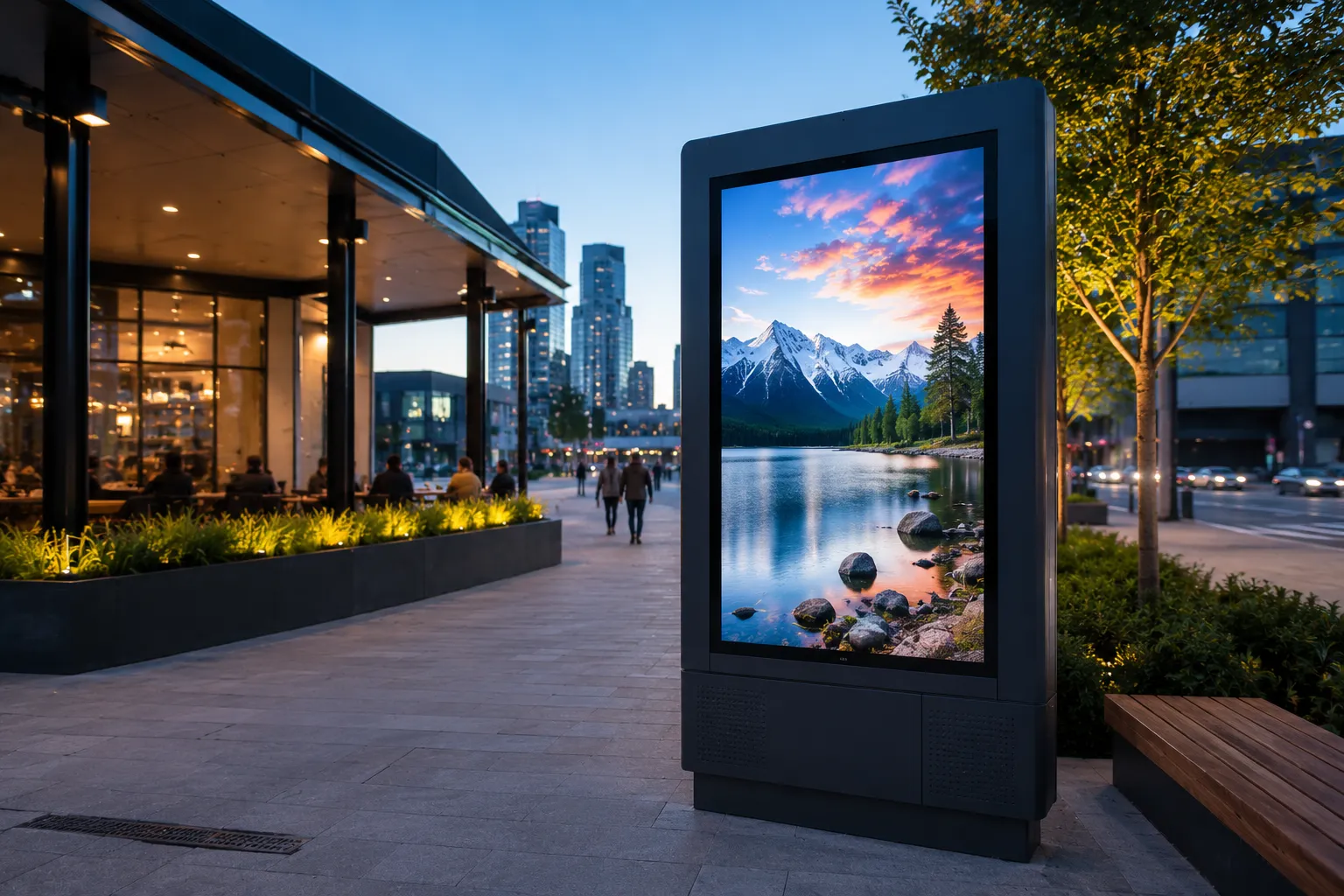
The outdoor signage solutions available in the market address these challenges. A high-quality outdoor digital screen is designed for a variety of weather conditions and direct sunlight. Waterproof construction and high contrast screens allow the digital signage to remain usable and intact for years. When you decide to go digital, you essentially decide to stop the ongoing cost to replace signage.
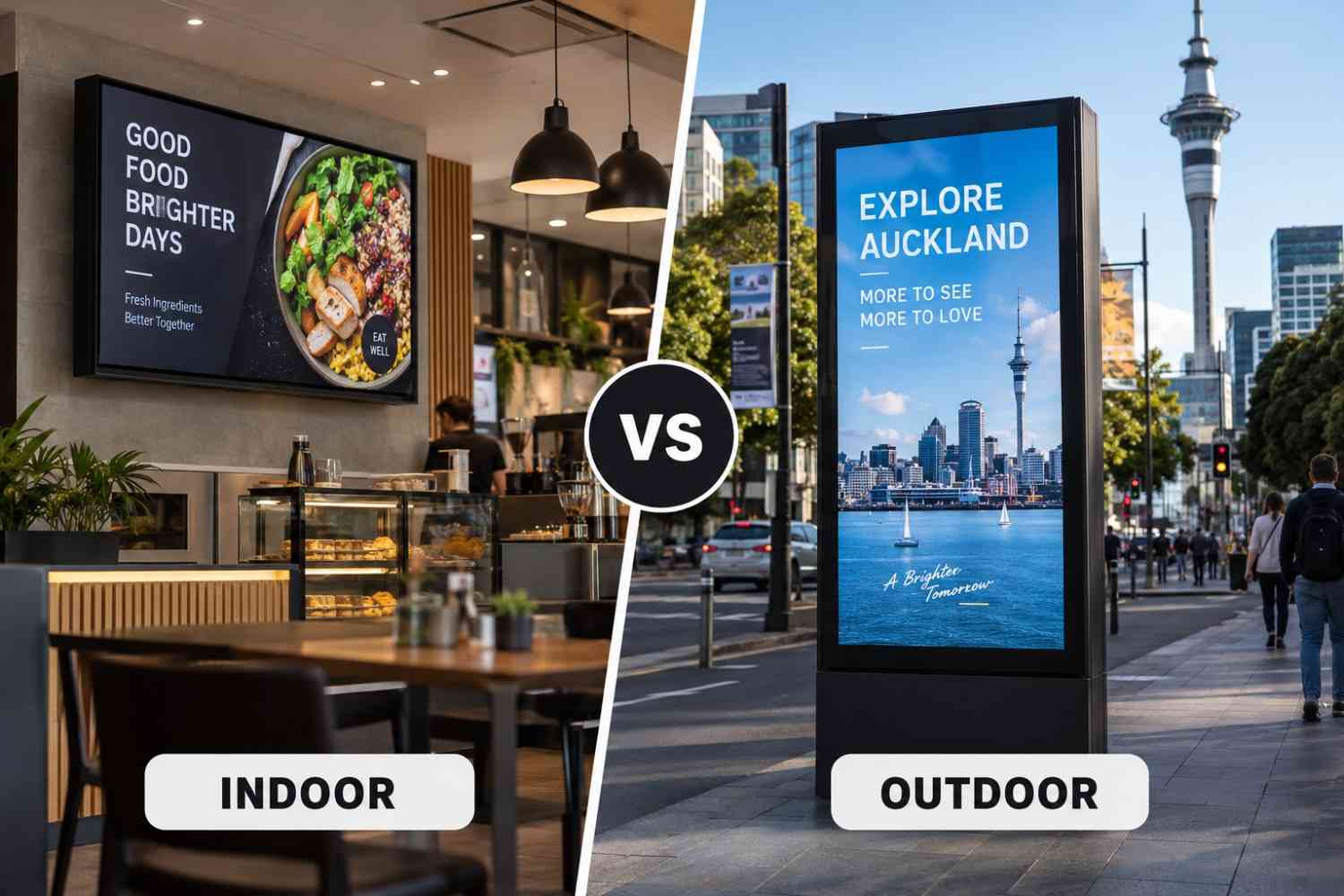
Outdoor Signage Solutions vs Traditional Outdoor Advertising
It helps to see the comparison laid out plainly, because the differences go beyond just looking modern.
| Factor | Traditional Signage | Outdoor Signage Solutions |
|---|---|---|
| Weather resistance | Degrades with sun and rain exposure | Built with weatherproof, sealed enclosures |
| Content updates | Requires reprinting | Updated remotely in minutes |
| Visibility in daylight | Fades and becomes hard to read | High brightness panels stay legible |
| Longevity | Months before replacement needed | Multiple years with proper maintenance |
| Flexibility | One message until replaced | Rotating promotions, menus, or announcements |
| Night visibility | Poor without external lighting | Self-illuminated, visible after dark |
The pattern is consistent across nearly every category. Traditional signage requires ongoing manual effort to stay current and legible, while digital signage does the opposite: it is built once and then managed remotely.
Considerations for Choosing Your Outdoor LED Display Screens
Not all screens with outdoor placement advertising can actually be placed outdoors. There are some technical elements that must be analyzed before making a selection for an outdoor LED display screen.
- Brightness (Nits). Outdoor screens need displays with significantly higher brightness so the displays can be seen in outdoor daylight as opposed to indoor screens. Screens with less than commercial grade brightness will be washed out in a clear afternoon in Auckland.
- IP Rating. An IP rating is an indication for how sealed a unit is for outdoor placement for both moisture and dust. A true outdoor screen would be rated for continuous outdoor placement as opposed to a unit that is rated for outdoor usage with incidental splashes.
- Range for Operating Temperatures. Outdoor screens would have to be rated for the high temperatures of summer and the low temperatures of winter with much more exposure to extreme temperature variations than indoor screens.
- Anti-glare, along with viewing angle, is the clear unobstructed reading of the screen in all directions along the sidewalk, where most of its value can be lost, as opposed to only having clear readability directly in front of the screen.
In fact, these ratings are so important that having a smaller outdoor rated display screen would outperform a larger display screen that is rated for indoor placement.
Types of Outdoor Screens NZ Businesses Use
Not every business is the same. Here’s how small business outdoor screens NZ way is diverse across the country.
Fixed Outdoor LED Display Screen
Companies wanting a permanent advertising screen use fixed Outdoor LED screens. They are perfect for cafes, restaurants, shops, or any business that needs visibility on the street for an extended period and prefers not to move the screen.
Portable Outdoor Screen Panels
Outdoor Screen Panels are made with either a wheeled or foldable stand and are suitable for businesses that pop up and down. Businesses that attend markets or set up temporary displays before they secure a permanent location will benefit from the flexibility of outdoor screen panels. Fixed screens offer great visibility.
Displays for Covered Areas
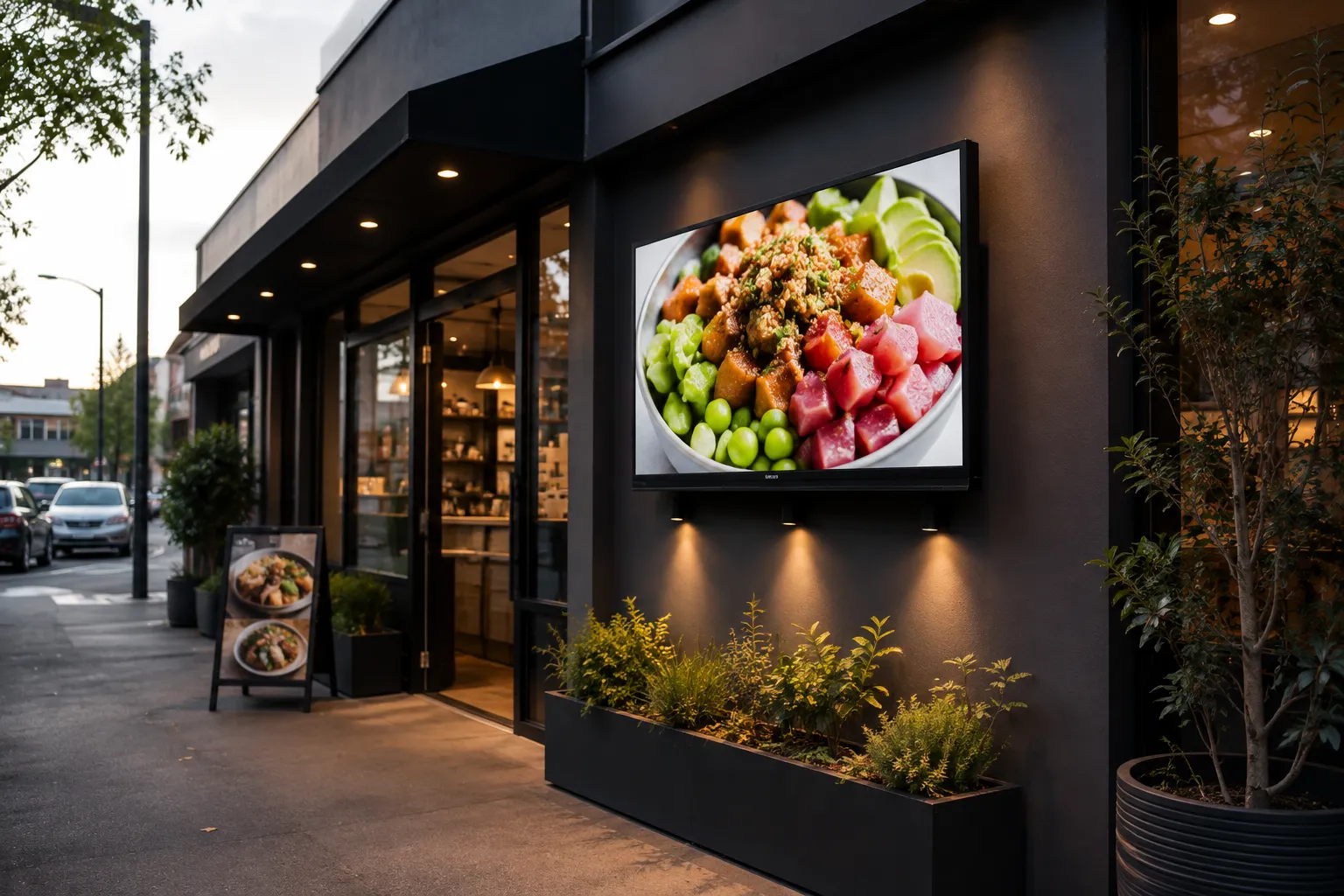
If your business has a covered entry (like an awning or veranda), then a Semi-Outdoor Display is perfect for you. Unlike fully Outdoor displays, these screens are not completely weatherproof and are designed to tolerate temperature and humidity changes and are made with a lighter build.
Where Outdoor Signage Solutions Have The Most Value
If you want to see how much value outdoor signage makes, you can look at the examples of outdoor signage by businesses of all sizes throughout the greater Auckland area.
A cafe can easily put an outdoor digital screen in front of the cafe for the bank account friendly purpose of advertising rotating breakfast and lunch specials, and staff will never need to step foot in the employee break room to change a single thing as the screen will automatically update. Same goes for retail; as soon as stock arrives, a retail shop can replace the old stock with a flash sale. Gyms can now easily place outdoor screens to promote membership offers and classes, now targeting potential new members from the busy walk past street traffic.
The beauty of this outdoor signage is the convenient timing. Signage is most effective when a business can send a message THAT SECOND, and outdoor signage is the best solution for THAT SECOND.
How to Choose an Outdoor Screen vs a Digital Signage Kiosk
When the time comes many small business owners weigh up the pros and cons of installing digital signage. Outdoor screens advertise passive content for passing pedestrians, while digital signage kiosks are built for active, direct customer content interaction such as scrolling through a service menu or checking product availability.
Passive content outdoor screens require no customer interaction and offers visibility. This is ideal for most retail and food store businesses. Digital signage kiosks are meant for customer interaction, and are ideal for self-service to reduce wait times, for higher customer traffic areas such as a shopping mall, transportation hubs, or large service centers. Most small businesses don’t require both options, and will benefit more from having the right solution for the customer traffic level, than having the higher level solution for customer interaction.
Problems When Auckland Businesses Use Outdoor Screens
We see similar problems when businesses set up outdoor displays with poor judgment.
- Using screens not rated for outdoor use. This is easily the biggest mistake and most expensive. It leads to the screen failing a few months later.
- Not considering the sun placement. Even a screen rated for outdoor use will not work well if the screen is installed with the sun hitting the panel for hours every day.
- Not using protection for cables/power. Exposed wiring is the fastest way an installation can fail when there are long days of heavy rain.
- Not using a maintenance plan. Outdoor screens collect dirt, and grime, condensation, etc. If outdoor screens are not checked for a long time, it will fail in ways that could have been detected early with regular periodic checks.
Why Some Digital Signage Companies excel at Outdoor Installations
Building outdoor digital signage is trickier than the indoor variety. If something goes wrong, it could be catastrophic. This is why selecting an installer is critical.
The better digital signage firms mount the screen and walk away. Outdoor digital signage requires assessing the exposure of the signs, and the viewing angles in the real world, in addition to the sign's specs for IP rating and the brightness needed for the location. This is in addition to sealing the wiring and connections from moisture exposure. There's a lot of potential damage that could occur to outdoor digital signage that companies need to be prepared for. The hardware that sits safely indoors doesn't get exposed to the elements and therefore doesn't wear like outdoor hardware.
When selecting a digital signage company for an outdoor project, it is prudent to ask about the outdoor project experience. Don't assume that indoor experience equates outdoor experience. They often are not.
Conclusion
With Auckland's weather, paper banners and printed posters were never a good option. Most small business owners have the same experience after replacing faded signs multiple times. Outdoor digital signage solutions are a good option as signage is designed to be weather proof and solve the problem at the source. Additionally, it allows business owners to change the digital content as often as needed.
The right option can be anything from a fixed outdoor LED display screen to portable outdoor screen panels or a display screen designed for a covered entryway. The priority is truly selecting legitimate signage designed for outdoor conditions and the company's commitment to the installation.
For the right outdoor signage for your Auckland business call Dynamic Displays for a no-obligation assessment at +64 21 281 5009.