While looking into digital signage displays for outdoor use for New Zealand businesses, you've probably realized that many different types of displays exist, and the jargon can be overwhelming. Each display uses different technologies and incorporates different components, including displays that use LED and LCD technologies, and may come with different IP ratings, display brightness, and pixel pitch. You may feel like you have to be an engineer to make an informed decision and purchase a display.
Fear not! You do not need to be an engineer to understand the few different display technologies that are applicable for outdoor digital signage. Unlike many business owners, you will avoid falling into the trap of the most common and costliest mistake of purchasing a display that looks good in a showroom, but will inevitably fail and not withstand the outdoor elements that New Zealand is known for.
This guide will help you understand the display technologies that are used for outdoor digital signage in New Zealand, and will help you understand the strengths and weaknesses of each, allowing you to choose the appropriate technology for your specific business needs.
Why Screen Technology is More Important Outdoors Compared to Indoors
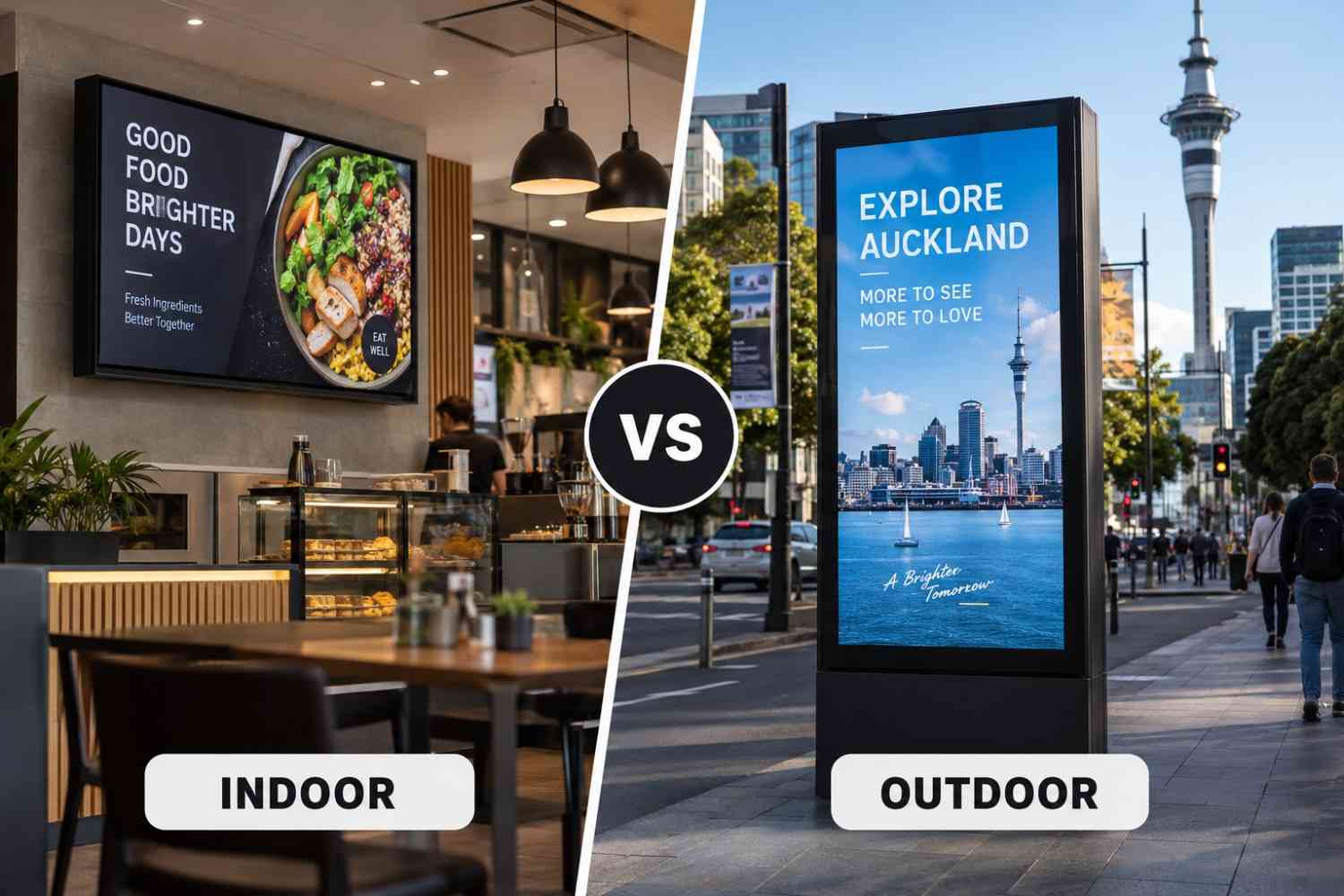
Indoors, many screens designed for commercial use can function well. Light is not an issue, temperature is even and there is no rain.
Outdoors, a screen needs to battle direct sunlight and not get washed out, needs to withstand temperature changes from an afternoon and evening, and needs to be sealed against long lasting rain and humidity. This is why outdoor digital signage is considered to be its own distinct category of hardware instead of an indoor screen used outside.
Here’s how different displays actually stack up against each other.
Best Digital Signage Display Screens for Outside
1. Outdoor-Rated LED Display Screens
Outdoor LED display screens are your best option for the majority of storefronts and are usually the recommended first choice.
LEDs are different from LCDs because they don’t use a backlight and instead generate their own light. Because of this, LEDs can achieve a much higher brightness and are the best option for areas of the country that have direct sunlight most of the time. This includes most of New Zealand’s Coastal and Northern Regions.
Strengths:
- Can achieve the highest brightness of any display technology
- Made for year-round outside use
- High lifespan when properly rated
Weaknesses:
- Higher pricing when compared to indoors LED screens
- Needs to be matched carefully to viewing distance in order to achieve the desired close-up visibility
2. Waterproof Outdoor LCD Screens
The second most common outdoor display technology choice is a waterproof LCD screen. Businesses looking for
higher detail and visibility at closer distances, like display screens for menu boards at the entrance of the store, usually opt for these screens.
Even though LCD displays are great for detail and color accuracy, to use them outside, they need to be sealed in a waterproof casing. They also need a backlight stronger than indoor LCDs in order to be visible. Without these, moisture and heat will significantly reduce the life of the LCD.
Strengths:
Excellent sharpness for images that may be viewed at close-range.
Excellent color accuracy for applications such as menus and product images.
Where it falls short:
Lessens the advantage of local dimming. Brightness and shading vary by placement.
Quality of enclosure effects reliability.
3. Outdoor Screen Panels (Modular LED)
Outdoor screen panels are modular LED systems designed for outdoor applications. Because they are modular, they can be integrated into custom outdoor applications that may require large screens, odd shapes, or integrated into a design rather than standard rectangular panels.
Strengths:
Can be made into custom sizes and shapes
Can grow, more panels can be integrated later
Where it falls short:
More complex to install than a standard fixed panel
Best for businesses with a planned layout rather than a simple screen setup
4. Semi-Outdoor Displays for Covered Areas
Some digital signage is not meant to be fully exposed to the elements. For covered store fronts with awnings or a recessed entry, a semi-outdoor display is a good compromise between an indoor display and an outdoor display.
These displays are designed for temperature control and are able to handle moisture so they can be more efficient for covered store fronts compared to outdoor displays with a full protective enclosure.
Strengths:
Darker build compared to fully outdoor-rated screens
Well suited to locations that have some covering but are still open-air
Where it falls short:
Not suited to locations that have direct exposure to rain or sun
Needs an evaluation of what is meant by "covered" in the location, as it can vary with the seasons
5. Transparent LED Displays
Transparent LED displays have recently been used in outdoor digital signage and can easily be installed on shop fronts. They display information while letting people see into the shop.
In New Zealand, Transparent LED displays are a specialized product compared to standard outdoor displays, and are suited to shops that want to draw attention to products while not fully obstructing the view into the shop.
Strengths:
While displaying information, attendees can still see the contents of the shop
Technology on Transparent LED displays creates interesting effects and draws attention to the displays.
Where it falls short:
A specialized product, best suited for shop display applications.
How to Select a Display Type for Your Storefront
- Instead of randomly choosing a technology, work with what you actually have.
- Plenty of sunlight, distant viewing (across a big parking lot or wide street): start with an outdoor LED display screen.
- Closer viewing (ex. a menu board right outside your entrance): use an outdoor weatherproof LCD screen. It has sharper detail for closer viewing.
- Covered entrance or veranda: use a semi-outdoor display. It protects your investment with weather proofing you actually need.
- Large installations you need to shape yourself: use outdoor screen panels to give you the flexibility of building to the space.
- Retail displays that face your street: use a transparent LED display. It lets you advertise while keeping an open view to your store.
Biggest Mistakes When Buying Outdoor Digital Signage
Most bad outdoor digital signage installations share similar mistakes.
- The first and biggest mistake is buying an indoor digital screen for an outdoor location. This mistake is by far the most common and expensive and usually ends with a failed digital signage system within the first year.
- The next mistake is not understanding brightness needs. A digital screen that looks bright in a showroom is not going to be bright when placed in direct sunlight in New Zealand.
- Another mistake is not understanding the meaning of IP ratings. Leaving out the meaning of IP ratings is a quick way to end up with a screen that is going to FAIL after heavy rainfall.
- The last big mistake is prioritizing size over technology. A large digital screen with the wrong technology for the location is going to perform worse than a smaller screen that is better technology for the location.
Questions to Compare Digital Signage Providers
With outdoor digital signage solutions, the installer is as important as the digital signage hardware you choose. Before you make your choice among the digital signage providers, ask the following questions:
- Have they done outdoor digital signage installations in the locations that you need?
- Do they guarantee the IP Rating and brightness level tailored to your site as opposed to a copy-and-paste generic answer?
- What type of continued service and support do they provide once the screen is operational?
- Is the installation of the screen, including all mounting and cabling, weatherproofed as part of the contract and scope of work?
Even the best outdoor digital signage screen solutions will fail, with poor installation. That is why, before you choose your digital signage hardware, you need to ask and evaluate the answers to all the above questions.
Where Does a Digital Signage Kiosk Belong in the Outdoor Discussion?
There are distinctions to be made between two terms. Much of the digital signage used outdoors rotates passive content. A digital signage kiosk is generally built to be directly interacted with by the customer to allow for content browsing, searches, or self-check-in.
For most small business storefronts, passive outdoor digital screens typically meet the demand. Digital signage kiosks are more suited for outdoor environments with high-traffic such as transportation hubs or event spaces, where the self-service actually helps ease the process for the customer.
Conclusion
When it comes to outdoor digital signage in New Zealand, it is important to understand the realities of each unique location so that you can tailor your offerings to the best of each situation. This means that more often than not, the best round choice for most storefronts is going to be outdoor-rated LED display screens. Other options, such as weatherproof LCD displays, semi-outdoor displays, modular outdoor screen panels, and transparent LED screens, can be considered when looking to fill a more specific need.
In most cases, the cost of replacing a screen that doesn’t meet the location specifications and customer needs is going to be way more than the cost of just getting specifications and needs correct the first time.
To get the type of display you need for your storefront, call Dynamic Displays on +64 21 281 5009. You will not be pressured and can get an actual need-based recommendation.